

There’s a number most small business owners have never calculated — and it’s quietly the most important number in their business.
It’s the hourly cost of their own time.
Not what they charge clients. What their time actually costs the business when they’re spending it on tasks that don’t generate revenue.
Do the Math
Let’s say you spend, conservatively, five hours per week on admin: invoicing, follow-ups, scheduling, onboarding, responding to routine inquiries.
That’s 260 hours per year.
Now, what’s your hourly rate? If you charge $100/hour, those 260 hours represent $26,000 in potential revenue — revenue you could have generated if those hours had gone to billable client work instead.
Even at a modest $75/hour, you’re looking at nearly $20,000 a year in opportunity cost.
That’s not a small number. That’s a hire. That’s a marketing budget. That’s the income gap between a stressful year and a comfortable one.
The question isn’t whether you can afford to automate. It’s whether you can afford not to.
The Hidden Cost Beyond Money
The financial cost is real, but it’s actually the easier one to stomach. The harder cost is what repetitive admin does to your energy and creativity.
Every hour you spend on manual invoicing is an hour you’re not spending on client work you love, on building the next stage of your business, or on the rest and recovery that makes sustained high performance possible.
Admin fatigue is real. It’s the reason so many talented business owners feel burned out not because they’re working too hard at their craft, but because they’re spending so much effort on the mechanical scaffolding around it.
Automation doesn’t just save time. It protects your energy — the resource that’s even harder to recover than time.
The ‘It’ll Take Too Long to Set Up’ Myth
The most common objection to building business systems is that setting them up takes time you don’t have.
It’s true that there’s an upfront investment. Building a client onboarding workflow from scratch might take two to three hours if you’re new to it.
But that’s a one-time cost that pays for itself within a single month of use — often within a single week. After that, it pays you back indefinitely.
The math is straightforward. A workflow that saves you three hours per week has paid for a three-hour setup cost in seven days. After that, it’s pure return.
Where to Start If You Feel Behind
If you’ve been running your business manually and the idea of setting up automation feels overwhelming, start with the smallest possible intervention.
What is the single most repetitive task you did this week?
Not the most complex. Not the most important. The most repetitive. The one you’ve done identically fifty times.
That’s your starting point. Build one workflow. Make it work. Then build the next one.
Businesses that run on great systems don’t get there in a weekend. They get there in the same way any meaningful change happens — through deliberate, incremental progress.
The Business You Could Be Running
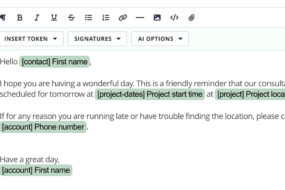
Imagine the version of your business where every new inquiry gets an immediate, professional response. Where every new client is onboarded smoothly without you managing each step. Where invoices go out on time and payment reminders run automatically. Where your schedule is always up to date and you never lose a lead because you forgot to follow up.
That business isn’t a fantasy. It’s just a business with better systems than yours currently has.
And the gap between where you are and where you want to be is smaller than you think.
The March 2026 issue of The Journey is entirely dedicated to helping you close that gap — with practical, jargon-free guidance on building the automations that free you to do your best work.

Read The Journey For More Small Business Education
March’s issue of The Journey is all about using automation to reclaim your time and create smoother, more scalable business systems. Instead of feeling overwhelmed by complicated tech, this issue shows small business owners how simple workflows, templates, and smart tools can quietly handle repetitive tasks — freeing you to focus on creativity, clients, and growth.
Latest Posts

Inside October’s Journey: From First Inquiry to Paid Invoice
October 15, 2026
How Business Consultants Protect Their Expertise With 17hats
October 9, 2026
Treat Your Collaboration Partners Like Clients
October 6, 2026