

What it actually takes for your business to keep running when you’re not at your desk.
Quick answer: Build the two systems that run without you first — a lead capture form that catches every enquiry the moment it arrives, and a workflow that follows up automatically after it. Layer scheduling, contracts, and payments on top once those are solid. That’s the order Melbourne celebrant Zee Scott recommends after ten years running three businesses this way.
Ten years ago, Zee Scott was on the other side of the world from her business.
She was in the UK visiting family — 10,000 miles from her Melbourne clients. She’d had the 17hats website bookmarked for a while, waiting for the right moment. Sitting that far from home, the moment arrived.
“Being on the other side of the world, I didn’t want to miss a single lead or opportunity back home in Melbourne — so it felt like the perfect time to sign up. I joined 17hats from my Mama’s kitchen table in London, and my business back in Australia didn’t skip a beat.”
That’s the whole idea, really. Not that you should work while you’re on holiday — that you shouldn’t have to. A business that only moves when you’re personally pushing it is a business that stops every time you step away: for a family trip, a sick day, a Saturday, a wedding you’re actually officiating.
Zee is a Melbourne-based Marriage Celebrant who’s been marrying couples since 2015. She also runs Bento + Bubbles®, her cake and celebration business, and With Zee Scott, where she mentors new celebrants. On top of that, she teaches the Certificate IV in Celebrancy at a Melbourne university.
So when she says her business runs without her hovering over it, she means three of them.
Here’s what has to be true for that to work.
Why isn’t being organized enough?
This is the part worth sitting with, because most business owners assume the fix is discipline.
“I’m not gonna lie, I have always been good with setting up systems — that’s definitely my strength. However, before 17hats everything lived on different systems. My invoices in Microsoft Word, my date + document tracker in Excel and I had to cross check everything from two calendars. So much time wasted just finding information and collating an answer, let alone acting on it.”
Read that again: she was good at systems. She had a tracker. She had calendars. But none of them talked to each other, so every simple question — is this date free, has this couple paid, did I send the contract — meant personally assembling the answer from three places.
That’s the tax. Not disorganization — reassembly. And reassembly is something only you can do, which means the business waits for you. It’s one of the quieter ways manual processes cost you money: the time doesn’t show up on an invoice, so it never gets counted.
How do you make sure no lead gets missed?
Zee’s lead capture forms embed directly into her websites, and every new enquiry gets an automatic response. That’s the obvious half.
The less obvious half is what she puts in that response:
“The lead auto-responder is brilliant for setting boundaries from the very first hello: it tells them ‘I got it’ but also ‘I’ll respond during working hours’ — which sets a healthy tone for our whole journey together.”
There’s something quietly clever here. Most people treat automation as a speed tool — reply faster, look more professional. Zee uses it as a boundary tool. It isn’t just confirming receipt; it’s teaching a brand-new client what working with her looks like.
Which means the 11pm enquiry gets a warm, immediate acknowledgment, and nobody’s expecting an 11pm answer. If you’re working on the stretch between first contact and signed client, we’ve covered that path in detail in how to convert leads into clients without chasing.
Can clients book and pay without you?
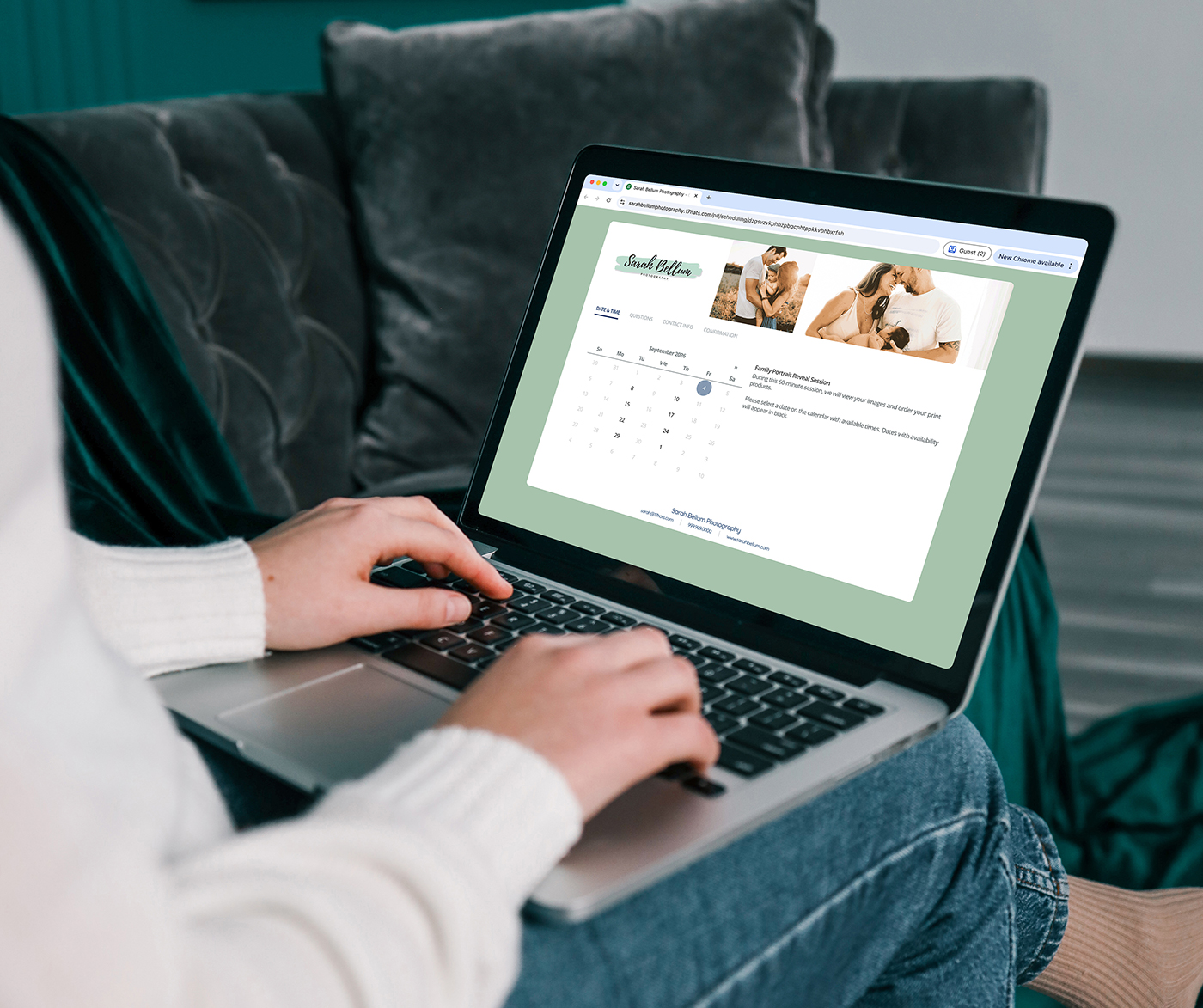
Zee’s Online Scheduling does what she calls triple duty: cake orders for Bento + Bubbles®, date-check calls for her couples, and mentoring session bookings for With Zee Scott. One tool, three businesses.
But this is her sharpest move, and it’s worth stealing:
“My favourite behind-the-scenes trick, though? Online Scheduling lets me ask questions when someone books, so a booking doubles as a lead. I can take payments as part of the booking process or a workflow will send my 3-in-1 document as soon as the booking has been made. That’s all before I’ve even opened my emails!”
A booking doubles as a lead. Because she asks the qualifying questions at the moment someone picks a time, the appointment arrives already carrying everything she’d otherwise collect over a week of emails. Then a workflow takes it from there — payment collected, paperwork sent — while she’s asleep, teaching, or at a ceremony.
That’s a client fully onboarded with zero minutes of her attention.
How do you stop chasing signatures and invoices?
Ask Zee for her favorite feature and there’s no hesitation.
“Definitely the 3-in-1 document. Quote, contract and invoice in one — my clients accept, sign and pay in a single sitting. It just makes getting paid so much easier. No chasing signatures, no ‘did you see my invoice?’ emails. One document, done.”
Every extra step between “yes, I want this” and “here’s my payment” is a place a booking can stall. Three separate documents means three chances to set it aside and mean to come back to it. One document means the decision and the payment happen in the same breath.
And “no chasing” matters more than it sounds — chasing is unbillable work only you can do, and it’s the first thing to pile up while you’re away.
How do you cut down on repeat client questions?
“The client portal is a quiet hero — my clients can check things like their invoice balance any time they like, without ever having to chase me.”
Every “hey, quick question, how much do I still owe?” is a small interruption that only exists because the information lives in your inbox instead of somewhere your client can reach it. Give them the key and the question stops being yours.
Nobody notices a portal. That’s the point — the best client experience improvements are usually invisible, which is exactly why it’s worth running a client experience audit to find the ones you’re missing.
What should you set up first?
We asked Zee what she’d build first if she had to start over tomorrow. It’s a good roadmap for anyone staring at a blank account:
“Lead capture forms first, then workflows. They’re the foundations — the form catches every enquiry the moment it arrives, and the workflow makes sure nothing gets dropped after that. Once those two are humming, it’s so much easier to layer everything else on top. Get the foundations right and 17hats does the rest.”
Forms, then workflows. Capture, then follow-through. Everything else — the 3-in-1, the scheduling, the portal — layers onto those two.
As for whether it holds up under load:
“The long and short of it… I run three businesses. There is simply no way I could keep on top of it all without 17hats!”
If it can carry three, it can carry yours.
And the reason it’s worth building at all? Zee is clear about that too.
“I get a front-row seat to one of the happiest moments of people’s lives — the laughter, the happy tears, all of it. It genuinely never gets old.”
That’s the actual job. The systems just make room for it — so the front-row seat is where you’re sitting, instead of at a desk reassembling answers from three spreadsheets.
Zee Scott – Wedding Celebrant

Zee Scott is a Melbourne marriage celebrant, good-vibes wrangler and occasional cake wizard — ten years marrying couples in Australia, three in the UK. She brings 20+ years of business and training experience, plus management roles in HR, retail and the arts. Qualified TAE Trainer and Assessor, she also trains the Cert IV in Celebrancy. Big bash or “just us” moment, couples leave feeling seen, supported and ready to show up.
Visit the Links Below to Learn More About Zee Scott:
Website: https://www.zeescott.com/
Instagram: https://www.instagram.com/zeescott__
FAQ
What business systems should a solopreneur set up first? Lead capture forms, then workflows. The form makes sure no enquiry is missed; the workflow makes sure nothing is dropped after it arrives. Scheduling, contracts, and payment collection are much easier to add once those two foundations are in place.
What is a 3-in-1 document? A single document combining a quote, a contract, and an invoice, so a client can accept, sign, and pay in one sitting instead of waiting on three separate items.
Can one 17hats account handle more than one business? Yes. Zee Scott runs three — her celebrant practice, Bento + Bubbles® (cakes and celebrations), and With Zee Scott (celebrant mentoring) — using the same account, with Online Scheduling handling a different booking type for each.
How do you set boundaries with clients without seeming unavailable? Send an automatic response to every new enquiry that does two jobs: confirms you received it, and states when you reply. The client gets immediate reassurance, and your working hours are set before the first real conversation.
Ready to build a business that keeps moving when you don’t? Start your free 17hats trial and set up your first lead capture form today.
Latest Posts

Inside October’s Journey: From First Inquiry to Paid Invoice
October 15, 2026
How Business Consultants Protect Their Expertise With 17hats
October 9, 2026
Treat Your Collaboration Partners Like Clients
October 6, 2026