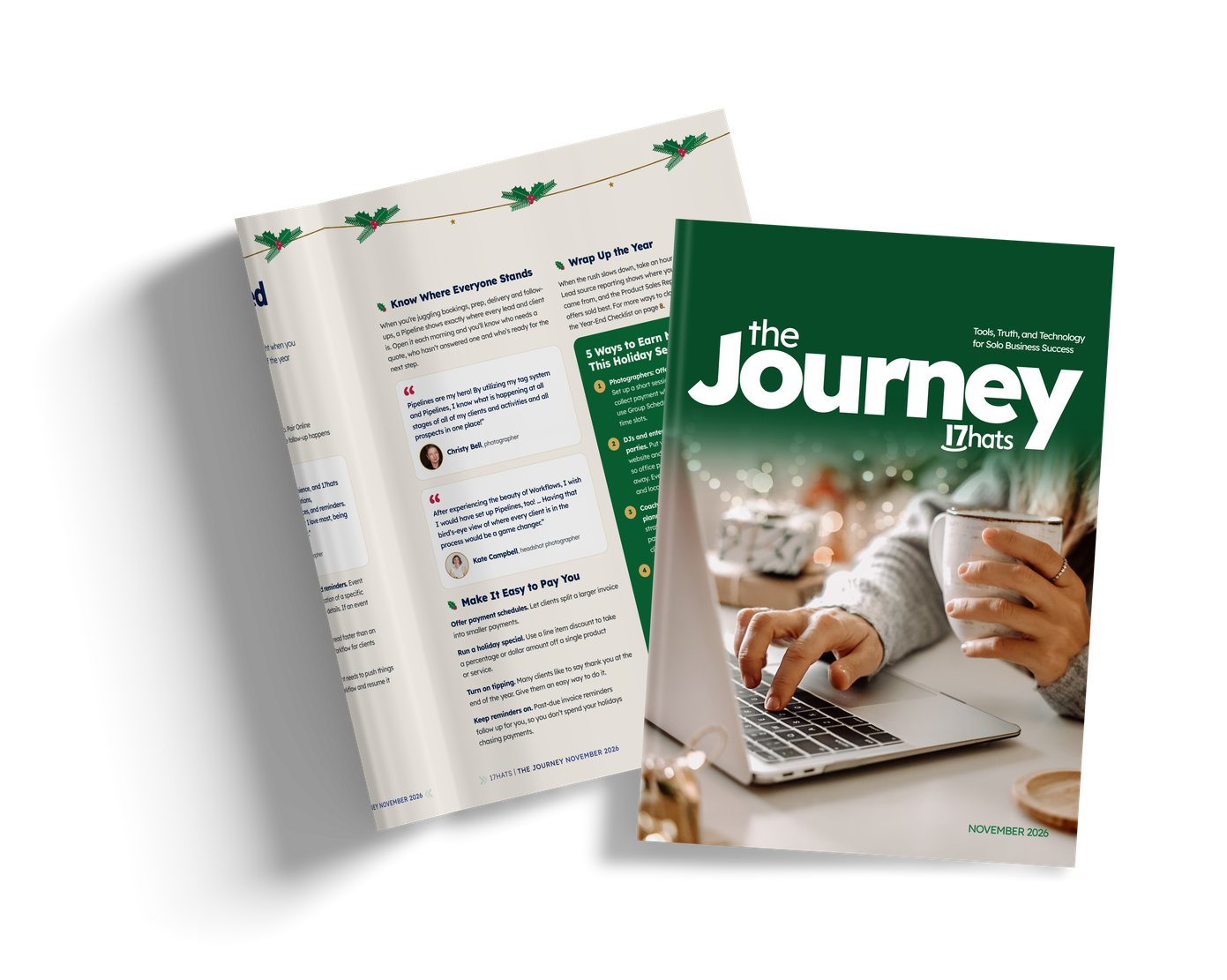


Adapted from the November 2026 issue of The Journey.
Think about your own inbox in mid-December. Every brand you’ve ever bought socks from wants to wish you happy holidays, usually with a GIF and a discount code. Most of it goes unopened, and that’s fair enough.
Your clients’ inboxes look the same. The holiday email you send has a small window to stand out from that pile, and a small service business has an advantage most of those brands don’t: your clients know you. They’ve talked to you, maybe sat across a table from you. A plain, short email with your name on it gets opened in a way a promo blast rarely does.
A holiday email that clients actually read usually has a subject line that says exactly what’s inside, arrives while the information is still useful, and is short enough to read on a phone in a checkout line. Above all, it does one job. If you take only one idea from this post, take that one.
One email, one job
The most common mistake is the everything email. Holiday hours, a thank-you, a gift card offer, a reminder about the unpaid invoice and a link to book for spring, all stacked under a festive header.
Clients skim it, catch the general mood, and miss the part that mattered (usually the dates you’re closed).
The November issue of The Journey splits the season into five separate emails, each with a single purpose:
| Its one job | When to send it | |
|---|---|---|
| Your holiday hours | Tell current clients when you’re closed | Early November |
| Holiday auto-responder | Let new leads know you got their message | When your break starts |
| Friendly payment nudge | Collect an open balance | Before the year closes |
| Book now for the new year | Fill your January calendar | December |
| Year-end thank-you | Say thanks, and invite referrals | As the year wraps up |
You don’t have to send all five. But if two of them are fighting for space in one email, split them up.
Subject lines that say what’s inside
Clever subject lines are fun to write. For a small business, though, they often get passed over, because the client can’t tell whether the email is about their project or a sale.
Here are the subject lines on the issue’s templates:
- Our holiday hours
- Thanks for reaching out!
- A quick note before the new year
- Ready to kick off the new year?
- Thank you for a great year
None of them would win an award, and every one tells the reader what they’re about to open. That’s what gets the click from someone who’s busy. Save the personality for the body of the email.
A few smaller things help too. Keep the subject short enough that it doesn’t get cut off on a phone. Skip ALL CAPS and the row of emoji, which look like they belong in the promotions folder. And if the client needs to do something, the subject can say so. “Our holiday hours (and the last day to book)” will do more for you than “Happy holidays!”
Timing matters more than wording
A perfectly written holiday hours email sent on December 20 is still a bad email. By then your clients have made their plans, and if they needed something from you before the break, it’s too late to ask.
So work backwards from when the reader needs to act.
Holiday hours go out in early November. Clients with projects in progress need weeks of notice. If you haven’t settled your dates yet, this post on holiday boundaries has sample wording for the hours themselves, your auto-reply and your response times.
The payment nudge goes out before year-end, while there’s still time to settle up in the current year. In 17hats, past-due invoice reminders handle most follow-ups automatically, so this one is for the cases where you’d rather send something personal. The template in the issue offers a different payment plan if that would help, and as the magazine points out, that offer is often all it takes to get a reply.
The new-year booking email goes in December, while people are already thinking about next year. Wait until January and you’re competing with everyone else’s new-year promotions.
The thank-you can go whenever it feels natural in the last couple of weeks of December. Nobody minds a thank-you that’s a few days late.
Shorter than you think
Every template in the issue is under 100 words, and that’s deliberate. Holiday email gets read on phones, in between other things, by people who are tired.
A useful test is whether you can read your email out loud in about 30 seconds. If you can’t, it’s probably doing more than one job. The first thing to cut is usually the paragraph recapping your year, and the second is any extra call to action.
What you shouldn’t cut is the personal part. The year-end thank-you in the issue mentions the client’s project by name, which costs you one token and makes the whole email feel written for them:
Hi [First name],
As the year wraps up, I wanted to say thank you. It was a joy working with you on [project name].
Small businesses like mine grow because of clients like you. If you know someone who could use [your service], I’d be grateful for the referral.
Wishing you all the best in the new year,
[Your name]
That’s about 60 words. It still asks for something, a referral, but the ask is small and it comes after the thanks. A note like this is also one of the easiest ways to stay top of mind with past clients without starting a newsletter.
Make it sound like you
Templates are a starting point, and using them word for word has a risk: if three photographers in the same town send the identical holiday email, somebody will notice.
Change a sentence or two so it sounds like the way you actually talk. If a blank page is the hard part, Hattie, the AI assistant in 17hats, can rewrite a draft in a warmer, more playful or more professional tone. Then read the result out loud once before you save it. If it sounds like a greeting card, rough it up a little.
In 17hats, the bracketed names become tokens like {Contact First Name} and {Project Name}, so each email fills in the right details for each client. Save them as templates once and next year the only thing you’ll change is the dates.
FAQ
When should I send holiday emails to clients?
It depends on the email. Holiday hours in early November, booking reminders in December, thank-yous in the last couple of weeks of the year. Send each one while the client can still act on it.
How long should a holiday email be?
Short. Under 100 words is a good target for most of them, and the templates in The Journey all come in under that.
Should I send one holiday email or several?
Usually a few small ones work better than one long one, because each gets a clear subject line and a single ask. Two or three is plenty for most businesses.
What’s a good subject line for a holiday email?
One that tells the client exactly what’s inside, like “Our holiday hours” or “Thank you for a great year.” Clear tends to beat clever.
All five templates are in the November 2026 issue of The Journey, ready to copy into 17hats. If you’d rather skip the copying, the free Holiday Email Template Pack in the 17hats Marketplace has all five plus four bonus templates, and they import straight into your account.
Latest Posts

How to Write a Holiday Email Clients Actually Read
November 17, 2026
Quote First, Talk Later: How to Respond to Inquiries Fast
November 12, 2026
Did You Miss These 2026 Updates?
November 10, 2026
How to Set Holiday Boundaries Without Losing Clients
November 10, 2026